

Join us at our next event.

Fall Seminar Series 2023 – Kuldeep Meel
Topic: Automated Synthesis: An Ideal Meeting Ground for Symbolic Reasoning and Machine Learning Next in our fall seminar series, we welcome Dr. Kuldeep Meel, Associate Professor of Computer Science at […]
Event DetailsFall Seminar Series 2023 – Kuldeep Meel
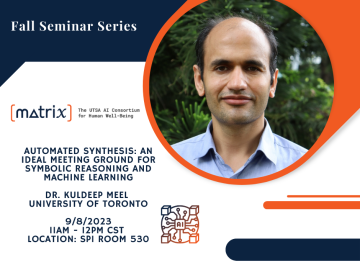
Topic: Automated Synthesis: An Ideal Meeting Ground for Symbolic Reasoning and Machine Learning
Next in our fall seminar series, we welcome Dr. Kuldeep Meel, Associate Professor of Computer Science at the University of Toronto.
Abstract:
In this talk, I will focus on one of the most fundamental problems in computer science: functional synthesis, which seeks to synthesize a system from a given relational specification. The synthesis problem is as old as propositional logic, tracing its origins to Boole’s seminal work in the 1850’s. Despite decades of work, scalability remains the fundamental challenge in functional synthesis. I will discuss a new data-driven approach, Manthan, that combines the power of machine learning with symbolic reasoning to achieve dramatic improvements in scalability. In particular, Manthan views functional synthesis as a classification problem, relies on advances in constrained sampling for data generation, and advances in automated reasoning for a novel proof-guided refinement and provable verification. The significant performance improvements call for interesting future work at the intersection of machine learning and symbolic reasoning.
You can see the presentation live at UTSA San Pedro I room 530.
Those who cannot attend in-person are welcome to tune in virtually through Zoom: https://utsa.zoom.us/j/91049981814.
Fall Seminar Series – Dharanidhar Dang
Topic: Silicon Photonics Computing: Remedy for Energy-draining AI Next in our fall seminar series, we welcome Dr. Dharanidhar Dang, Assistant Professor in the Department of Electrical & Computer Engineering at […]
Event DetailsFall Seminar Series – Dharanidhar Dang
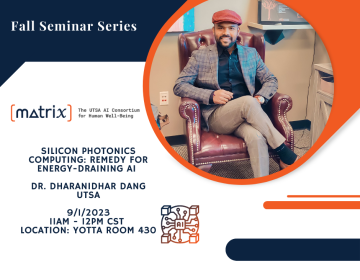
Topic: Silicon Photonics Computing: Remedy for Energy-draining AI
Next in our fall seminar series, we welcome Dr. Dharanidhar Dang, Assistant Professor in the Department of Electrical & Computer Engineering at the University of Texas, San Antonio (UTSA).
Abstract:
AI and in particular deep learning compute demand is growing exponentially. In fact, 10 times a year. What makes it worse is, the AI growth is 5 times more than that of Moore’s Law. To give a perspective, training the latest GPT model with the best of GPUs costs 4.6M $ of electricity and it is going to get worse further. Now, to think of fast-decision making with limited power budget, traditional computing systems cannot offer the required energy efficiency. Gladly, silicon photonics with its ultra-low power characteristics, high-speed nature, and large-scale parallelism gives us immense hope to address these challenges.
In this talk, I will demonstrate how I utilize a variety of silicon photonic components along with emerging memory such as resistive memory to design next-generation end-to-end deep learning accelerator which can demonstrate two order or more improvement in energy efficiency and speedup compared to the state-of-the-art. The talk also includes the showcase of a novel photonic backpropagation accelerator which is a first of its kind. Finally, I will end the talk with several future directions to tackle critical problems in the real world.
You can see the presentation live at UTSA San Pedro I Yotta room 430.
Those who cannot attend in-person are welcome to tune in virtually through Zoom: https://utsa.zoom.us/j/91049981814.
Spring Seminar Series – Dr. Hongseok Namkoong
Topic: A New Computation-driven Framework for Adaptive Experimentation Next in our spring seminar series, we welcome Dr. Hongseok Namkoong, Assistant Professor in the Decision, Risk, and Operations division at the […]
Event DetailsSpring Seminar Series – Dr. Hongseok Namkoong
Topic: A New Computation-driven Framework for Adaptive Experimentation
Next in our spring seminar series, we welcome Dr. Hongseok Namkoong, Assistant Professor in the Decision, Risk, and Operations division at the Columbia Business School.
Abstract:
Experimentation serves as the foundation of scientific decision-making. Adaptive allocation of measurement effort can significantly improve statistical power. However, implementing standard bandit algorithms, which assume continual reallocation of measurement effort, is challenging due to delayed feedback and infrastructural or organizational difficulties. To address this, we introduce a new framework for adaptive experimentation, motivated by practical instances involving a limited number of reallocation epochs in which outcomes are measured in batches. Our framework diverges from the traditional theory-driven paradigm by utilizing computational tools for algorithmic design.
We observe that normal approximations, which are universal in statistical inference, can also guide the design of scalable adaptive designs. By deriving an asymptotic sequential experiment, we formulate a dynamic program that can leverage prior information on average rewards. We propose a simple iterative planning method called Residual Horizon Optimization, which selects sampling allocations by optimizing a planning objective. Our method significantly improves statistical power over standard adaptive policies, even when compared to Bayesian bandit algorithms (e.g., Thompson sampling) that require full distributional knowledge of individual rewards. Overall, we expand the scope of adaptive experimentation to settings that pose difficulties for standard adaptive policies, including problems with a small number of reallocation epochs, low signal-to-noise ratio, and unknown reward distributions.
This work was led by Ethan Che. Paper link: https://arxiv.org/abs/2303.11582.
You can see the presentation live at UTSA San Pedro I Yotta room 430.
Those who cannot attend in-person are welcome to tune in virtually through Webex: https://utsa.webex.com/utsa/j.php?MTID=m568fe3d73989cb26d676f896e952c3c0.
2023 Neuro-Inspired Computing Elements (NICE) Conference
Where neuroscience meets next-gen computing UTSA is proud to host the 10th annual NICE 2023 Conference, bringing together global leaders in neuromorphic computing — a field focused on building machines […]
Event Details2023 Neuro-Inspired Computing Elements (NICE) Conference
Where neuroscience meets next-gen computing
UTSA is proud to host the 10th annual NICE 2023 Conference, bringing together global leaders in neuromorphic computing — a field focused on building machines that mimic the brain to enable faster, more efficient AI.
Keynotes include leaders from UC San Diego, UT Austin, IBM, NIST, and more. Tutorials by Intel, Sandia, and Heidelberg will dive into the latest neuromorphic tools and chips.
- NICE workshop: Tuesday, 11 April – Thursday, 13 April 2023
- NICE hands-on tutorials day: Friday, 14 April 2023
Venue
On site attendance at the University of Texas in San Antonio (UTSA.edu) (pending any COVID related changes).
Focus
The 2023 Neuro-Inspired Computing Elements (NICE) Conference is the 10th annual meeting of researchers in the neural computing field. Like previous editions, NICE 2023 will focus on the interplay between neural theory, neural algorithms, neuromorphic architectures and hardware, and applications for neural computing technology.
NICE aims to involve diverse participation from all over the world and bring together research communities with universities, government, and industry.
Call for papers – open until 11 December 2022
The submission of 4-8 pages papers is open HERE at easychair.
Papers should cover unpublished work and emphasize the novel aspects and the potential impact on the neural computing community. Preference will be given towards submissions describing ambitious approaches to bringing neural inspiration into real-world computing applications. From these submissions we will invite several short talks, lightning talks, and poster presentations.
We also welcome Abstracts (1-2 pages) for ‘Work in Progress’ or ‘Late Breaking News’. These submissions will be considered for poster presentations, lightning talks or demonstrations when applicable. These submissions will not be considered for the proceedings.
As with previous years, NICE is planning on publishing an online proceedings volume, details are below. Authors can also opt out of including their paper in the proceedings.
| Submission deadline | December 11, 2022 |
| Notification of Acceptance | February 1, 2023 |
| Camera-ready Submission | February 27, 2023 |
List of Topics
Listed below are the topics for the conference, together with a non-exhaustive list of relevant sub-topics.
- Architectures and Hardware
- Neuromorphic Hardware
- Analog/Mixed-Signal and Beyond-CMOS Hardware
- Compute-In-Memory Architectures
- Next-Generation Architectures
- Computational and Systems Neuroscience
- Neural circuits: Theory and Experimental Support
- Local learning and Plasticity
- Connectomics
- Neural Algorithms and Machine Learning
- Neuroscience-Inspired Algorithms
- Resource-Constrained and/or Hardware-Aware Artificial Neural Networks
- Spiking Neural Networks
- Neuromorphic Computing Applications
- Emerging Applications
- Robotics and Automation
- High-Performance Computing
- Edge Computing
- Biosignal Processing and Brain-Computer Interfaces
- Bio-Inspired Sensing
- Event-Driven Sensing
- Novel Neuromorphic Sensors
- Efficient Spike-Based Information Coding and Processing
- Algorithms and Software Frameworks for Neuromorphic Computing
- Tools and Programming/Mapping Frameworks
- Benchmarks, Neuromorphic Datasets
- Theoretical Frameworks and Models for Neuromorphic Engineering
- Memory-efficient Spike-Based Simulators
Tutorials
Tutorials will be offered on Friday, 14 April 2023.
Please contact Dr. Brad Aimone ([email protected]) if you are interested in presenting a tutorial at the conference.
Special Seminar Series – Dr. Nancy Chen
Topic: Neural Language Generation: From Self-Supervised Representation Learning to Multimodal Contextualization Next in our spring seminar series, we welcome Dr. Nancy Chen, Infocomm Research (I2R), A*STAR (Agency for Science, Technology, […]
Event DetailsSpecial Seminar Series – Dr. Nancy Chen
Topic: Neural Language Generation: From Self-Supervised Representation Learning to Multimodal Contextualization
Next in our spring seminar series, we welcome Dr. Nancy Chen, Infocomm Research (I2R), A*STAR (Agency for Science, Technology, and Research), Singapore.
Abstract:
The recent rapid advancements of neural language models have awed both domain experts and laymen alike. Such language models can fuel many natural language generation applications, including summarization, conversational agents, and machine translation. In this talk, we will illustrate how to harness the capabilities of these language models from a research perspective to address on-going technical challenges. In particular, we will delve into four research themes: scalable data augmentation, factually consistent generation, controllable neural modelling, and multimodal contextualization.
Those who cannot attend in-person are welcome to tune in virtually through Webex: https://utsa.webex.com/utsa/j.php?MTID=m568fe3d73989cb26d676f896e952c3c0.
Spring Seminar Series – Dr. Irene Chen
Topic: Beyond Bias Audits: Bringing Equity to the Machine Learning Pipeline Next in our spring seminar series, we welcome Dr. Irene Chen from Microsoft Research. Abstract: Advances in machine learning […]
Event DetailsSpring Seminar Series – Dr. Irene Chen
Topic: Beyond Bias Audits: Bringing Equity to the Machine Learning Pipeline
Next in our spring seminar series, we welcome Dr. Irene Chen from Microsoft Research.
Abstract:
Advances in machine learning and the explosion of clinical data have demonstrated immense potential to fundamentally improve clinical care and deepen our understanding of human health. However, algorithms for medical interventions and scientific discovery in heterogeneous patient populations are particularly challenged by the complexities of healthcare data. Not only are clinical data noisy, missing, and irregularly sampled, but questions of equity and fairness also raise grave concerns and create additional computational challenges.
In this talk, I present two approaches for leveraging machine learning towards equitable healthcare. First, I examine how to incorporate differences in access to care into the modeling step. Using a deep generative model, we examine the task of disease phenotyping in heart failure and Parkinson’s disease. Second, I demonstrate how to address one specific health disparity through the early detection of intimate partner violence from clinical indicators. Using a time-based model with noisy labels, we can correct for biases in data measurement to learn more clinically useful subtypes and improve prediction. The talk concludes with a discussion about how to rethink the entire machine learning pipeline with an ethical lens to building algorithms that serve the entire patient population.
Those who cannot attend in-person are welcome to tune in virtually through Webex: https://utsa.webex.com/utsa/j.php?MTID=m568fe3d73989cb26d676f896e952c3c0.