

APRIL 2025 — This month, we’re celebrating the vibrant activities and achievements across the MATRIX community.
From sparking meaningful dialogue through Birds-of-a-Feather sessions to recognizing excellence in research and innovation, our team continues to make strides in advancing human-centered AI. Explore highlights on exciting workshops, impactful research on sleep and PTSD, and the inaugural recipients of the MATRIX AI Scholar badge. Join us in celebrating these accomplishments and stay connected to the initiatives shaping the future of AI and human well-being. Check out the full details below!
-
APRIL 2, 2025 — At MATRIX, we’re dedicated to keeping our team and community inspired. Our recent ‘Birds-of-a-Feather’ sessions have been a fantastic way to engage everyone, sparking meaningful discussions and gathering valuable feedback.
A special thank you to our co-hosts, Drs. Kevin Desai, Amanda Fernandez, and Fred Martin, for leading a successful session at our NSF AI Spring School. We’re excited to support the innovative ideas generated during these discussions!
-

APRIL 3, 2025 — Don’t miss your last chance to submit your research proposal for the NSF ScooterLab Workshop! Researchers from academia, industry, and government are invited to submit brief proposals that explore novel applications of ScooterLab’s sensing infrastructure and data capabilities. Selected teams will be invited to showcase their work and receive travel support.
-

APRIL 8, 2025 — Congratulations to Dr. Gabriela Ciocarlie on her well-deserved recognition as a 2025 Golden Core recipient by the IEEE Computer Society!
This prestigious honor highlights her outstanding contributions and dedicated volunteerism in advancing the society’s mission.
-
APRIL 8, 2025 — Tej Pandit has been honored with the UTSA Outstanding Ph.D. Dissertation Award for his work on Scalable Continual Learning using Cascading Hypernetworks and Cellular Automata, presented by The UTSA Graduate School.
His research introduces a novel AI framework that enables systems to continuously learn and identify new tasks automatically—paving the way for more adaptable, efficient AI systems. Congratulations, Tej!
-
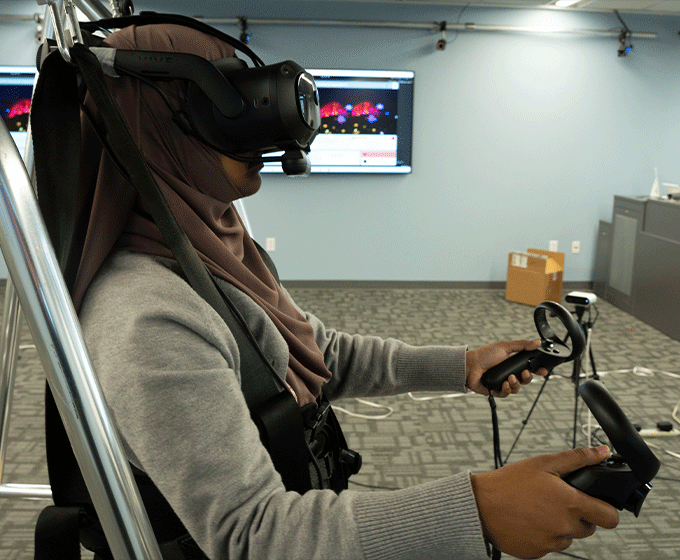
APRIL 10, 2025 — MATRIX AI Consortium core members Dr. John Quarles and Dr. Kevin Desai, along with collaborator Dr. Alberto Cordova, are exploring how visual feedback methods can improve walking in immersive VR for individuals with mobility challenges. Their work in refining interface design and reimagining VR environments reflects MATRIX’s mission of people-first AI with real-world impact.
-
APRIL 14, 2025 — We invite our MATRIX community and all those interested to attend the inaugural Spring 2025 NIH AIM AHEAD MATCH workshops. These free sessions offer a unique opportunity to explore cutting-edge topics in AI and biomedical research.
Join us on April 22 at 3:00 PM Central for a session on Continual Learning Methods and Applications with Dr. Jayanta Dey, and again on April 29 at 3:00 PM Central for insights into Generative AI for Biomedical Decisions with Dr. Sambit Panda and Christian Cruz. We hope to see you there!
-

APRIL 17, 2025 — MATRIX proudly recognizes the inaugural recipients of the MATRIX AI Scholar badge. A total of 41 individuals earned this distinction for their active participation in the 2025 NSF AI Spring School, a three-day program focused on cutting-edge advancements in AI and machine learning for edge systems.
Participants explored key topics such as neuro-inspired algorithms, privacy-preserving models, energy-efficient ML, and neuromorphic systems. Developed in partnership with The UTSA Graduate School, this microcredential reflects our shared commitment to accessible, hands-on learning that prepares scholars for the future of AI.
-
APRIL 21, 2025 — In partnership with the MATRIX AI Consortium, UTSA Research successfully launched its Opportunity Alignment strategy, a bold, data-informed approach to securing research funding with AI at the forefront.
The half-day workshop brought together researchers from across UTSA to assess institutional AI strengths, align expertise with sponsor priorities, and chart a roadmap for strategic growth and collaboration. This initiative marks a significant step toward strengthening interdisciplinary partnerships and expanding research opportunities across the university.
-
APRIL 24, 2025 — MATRIX AI Consortium core member Dr. Itamar Lerner, recipient of both the NSF CAREER award and NSF EFRI BRAID award, is advancing research on sleep and memory at UTSA’s Sleep and Memory Computational Lab. He is leading pilot studies exploring how REM sleep influences PTSD, particularly among emergency responders in San Antonio and Austin. His work reveals new insights that may inform how we treat PTSD, showing how improving sleep and designing energy-efficient AI algorithms could play a critical role in recovery.
-

APRIL 24, 2025 — Researchers at the UTSA Sleep and Memory Computational Lab are investigating how Rapid Eye Movement (REM) sleep impacts individuals regularly exposed to high-stress situations, potentially increasing their risk of developing Post Traumatic Stress Disorder (PTSD). Professor Itamar Lerner explains that their hypothesis suggests REM sleep influences how the brain processes threatening situations, depending on the predictiveness of associated cues. Confirming this could have important clinical implications and deepen our understanding of memory processing in the brain.


